

An interesting study was published this week in the New England Journal of Medicine that I believe is worth sharing with you.
It's a one-time IV infusion that permanently turns off a gene in your liver. The result? LDL cholesterol drops by more than 60% and stays down. No daily pill. No monthly shot. One and done.
Sounds promising. And it might be. But I want you to hear the whole story before making any conclusions.
Let me break it down.
What Is PCSK9, And Why Should You Care?
The NEJM study discusses how VERVE-102 can edit your genes, permanently altering your PCSK9 gene.
Before we dive any deeper, I want everyone to be on the same playing field. What is PCSK9, and why should you care?
Your liver has little vacuums on its surface called LDL receptors.
Their job is to remove ApoB and LDL particles from your bloodstream. The more of these vacuums you have, the lower your LDL.
Your body also makes a protein called PCSK9.PCSK9 has one job: it destroys those vacuums. So the more PCSK9 you have, the fewer LDL receptors you have, and the higher your LDL.
Why does this matter?
Scientists discovered that some people are born with a broken PCSK9 gene. Their LDL is naturally low throughout their lives, and they almost never develop heart disease. We're talking about an 88% reduction in coronary events in some studies.
These patients hit the genetic lottery.
So the question drug companies have been chasing for 20 years is: can we give everyone else that same protection?
VERVE-102: What The Trial Tested
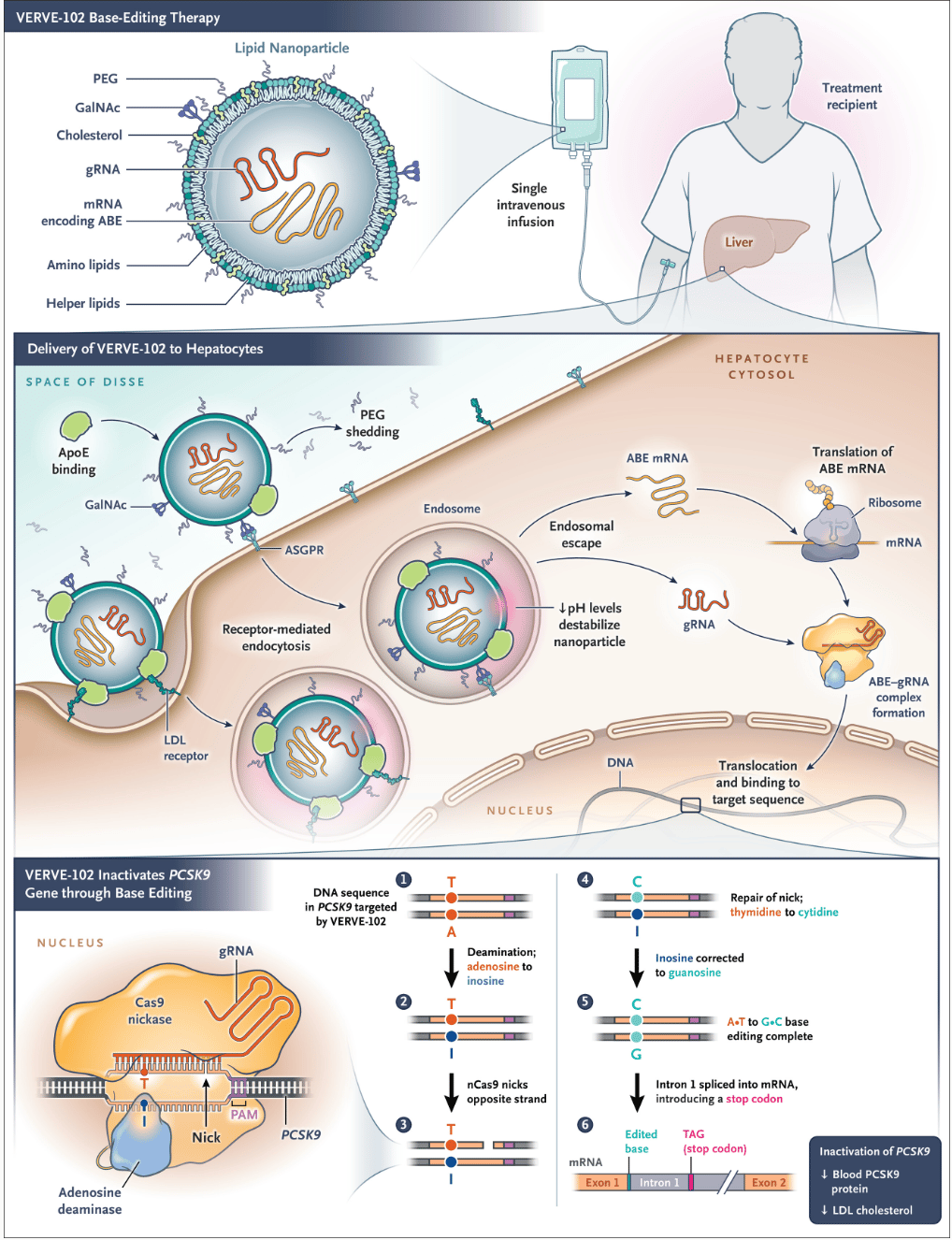
A company, Verve Therapeutics, ran a small phase 1 trial of a drug called VERVE-102. Here's what happened.
They take a tiny molecular machine called an adenine base editor — think of it as a microscopic pencil that can make a single, precise edit to your DNA.
They pair it with a guide that tells the pencil exactly which DNA letter to change. They wrap the whole package in a fat bubble (a lipid nanoparticle) that can find your liver cells. You get one IV infusion.
The package gets delivered to your liver. The edit happens. The PCSK9 gene is permanently switched off.
The trial enrolled 35 adults — people with premature coronary artery disease or familial hypercholesterolemia (a genetic condition that gives you dangerously high cholesterol from birth). They tested six different doses, from low to high.
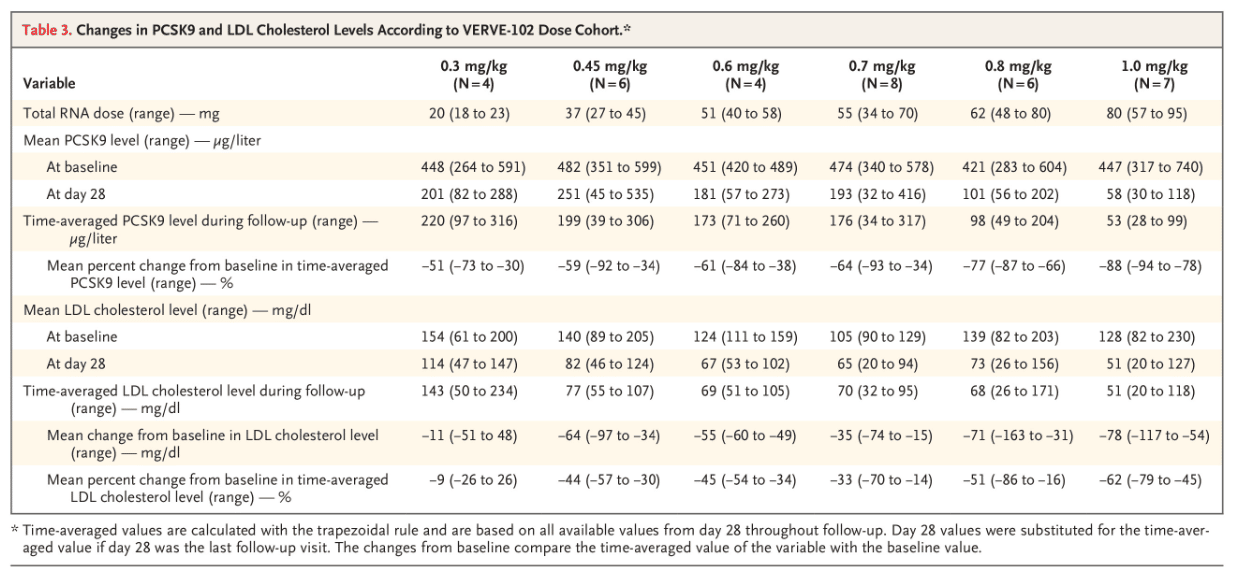
Here's what they found at the highest dose:
- PCSK9 protein in the blood dropped by 88%
- LDL cholesterol dropped by 62% — that's 78 mg/dL reduced
- For the patients followed for one year, the medication's efficacy remained
One infusion. No daily pills or weekly shots, and a 62% LDL drop.
DNA is permanently changed.
Concerns & Considerations
Realistically, we are about 10 years away from this getting FDA-approved and offered to patients outside of the study protocol.
Though this is promising, especially in patients with familial hypercholesterolemia, there are concerns.
The most alarming: this is permanent. You can't undo a gene edit.
If unexpected effects show up in five years, ten years, twenty years — there is no off switch. With a pill, you stop taking it. With a shot, you stop getting it. With this? What is done is done.
Off-target editing. The editing is precise — but not perfect. There's always a risk that the editor edits a letter that it shouldn't. The trial didn't see obvious signs of this, but with 35 patients, you wouldn't necessarily identify a rare problem.
Small and short-term follow-up. Thirty-five patients are suitable for a phase 1 trial, but we have a long way to go before we have population data. Additionally, only 15 of the 35 patients have been followed for a full year. Not long when you're talking about a permanent change to someone's DNA. We don't know what year five looks like. Or year fifteen.
Cost and access. Gene-editing therapy like this can cost hundreds of thousands of dollars.
Bottom Line: Is This the End of Statins?
This is exciting science. The data is promising for a phase 1 trial, the biology makes sense, and the demand is certainly there.
Let's consider the alternatives for a moment: statins, ezetimibe, and injectable PCSK9 inhibitors. A 62% reduction in LDL observed in the trial is significant but achievable with any of the above, either alone or in combination.
If any symptoms, side effects, or problems arise with statins, ezetimibe, or PCSK9 inhibitors, you have the option to opt out.
Will the benefit of VERVE-102 be worth the trade-off?Is it worth walking through a one-way door with no return? Do you think this is the next evolution of cholesterol treatment?
In the meantime, the things that protect your heart haven't changed:
- Don't smoke.
- Move your body every day.
- Eat real food.
- Sleep.
- Manage your blood pressure.
- Know your numbers.
If your LDL is still high, talk to your doctor about the options we already have, which are excellent.
The future is coming. But the basics still win, today.
Knowing Your ApoB Levels
Apolipoprotein B (ApoB) is not included in a standard lipid panel and is rarely included on routine annual labs.
That's starting to change. The new 2026 ACC/AHA cholesterol guidelines now recommend ApoB testing to sharpen cardiovascular risk assessment — because ApoB directly quantifies the number of atherogenic lipoproteins, providing a more accurate measure of atherogenic particle burden than LDL-C.
Essentially, ApoB counts the actual number of artery-clogging particles in your blood, which can be a more accurate measure of risk than LDL-C alone.
Function Health is an all-in-one health platform that starts with 160+ lab tests, covering your heart, hormones, liver, kidneys, thyroid, immune system, cancer signals, toxins, and key nutrients.
That’s about 5× more testing than standard primary care labs—bloodwork that would normally cost thousands of dollars out of pocket.
Scheduling is simple, with 2,000+ lab locations across the U.S., and most visits take around 15 minutes.
If you are interested in knowing your ApoB level, see if Function is a good fit for you.
Click here to sign up for Function Health for less than $1/day
Only the best,
Jeremy London, MD
P.S. Don't forget to follow my podcast for free on Spotify or Apple Podcasts
Related Articles


.jpg)




.jpg)
.jpg)





































Subscribe for Free to Keep Reading
This content is free, but you must be subscribed to keep reading.