


"They had normal cholesterol levels and still had a heart attack. How is this possible? Does cholesterol actually matter?"
This line of questioning and logic is reasonable.
How can someone with normal LDL-C levels still have a heart attack?Should we be worrying about cholesterol at all?
We will address this head-on in today's article.
It's worth pointing out that blockages, plaque accumulation, and atherosclerosis are not the only cause of a heart attack. Arrhythmias, spasms, and structural problems are additional reasons.
However, in today's newsletter, we will focus on the most common cause: ischemic heart attacks resulting from blockages in the coronary arteries.
Normal ≠ Optimal
Normal does not mean safe.
Normal or in-range blood test results don't automatically give you the stamp of approval that you are in the clear.
All this means is where your results fall in relation to the rest of the population.
Ironically, we live in a population where heart disease is the leading cause of death.
So, normal is not the goal. Optimal is.
ApoB, LDL-P, and Lpa Matter More
It's not the cholesterol that does the damage. It's the particles.
This is the part most people don't know.
When we measure "LDL cholesterol," we're measuring the cargo. The cholesterol being carried inside LDL (low-density lipoprotein) particles. But cholesterol floating in your blood isn't what damages your arteries.
The damage comes from the particles themselves burrowing into the artery wall.
Think of it like trucks on a highway.
Your LDL-C tells you how much cargo is on the road. It tells you almost nothing about how many trucks there are.
Two people can have identical "normal" LDL cholesterol, but one of them has far more particles circulating — more trucks, more chances for one to crash into the artery wall and start a plaque.
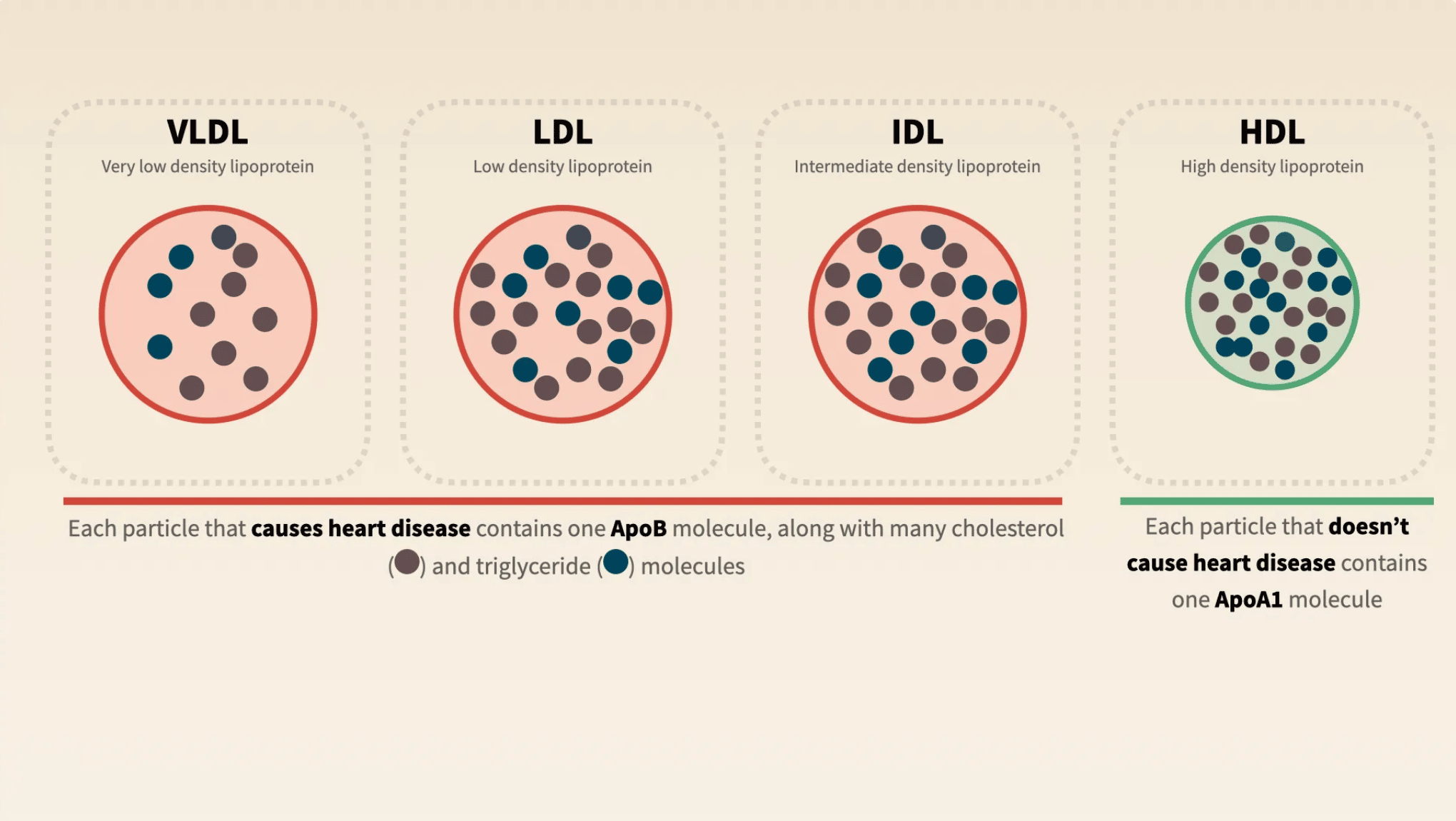
The number we should be looking at is ApoB (Apolipoprotein B), which directly counts those particles.
Every atherogenic particle carries exactly one ApoB molecule, revealing the truth the standard panel overlooks.
Two people could have ideal LDL-C numbers but different ApoB levels.
Another particle not accounted for by LDL-C is Lp(a), or lipoprotein (a).
It's largely genetic; it doesn't move much with diet or exercise, and roughly one in five people carries a dangerous level of it.
It's rarely tested on a standard lipid panel, and an Lp(a) particle is significantly more atherogenic than an LDL particle.
So you can have pristine LDL-C levels your entire life and be walking around with a potent, inherited driver of heart attacks and strokes.
Intima Health is Paramount
Cholesterol (ApoB, Lp(a), LDL, etc.) is only one bucket of the equation.
Endothelial health and vascular vulnerability are equally as important.
In other words, how susceptible are your arteries to allowing ApoB particles to penetrate and trigger the cascade of atherosclerotic coronary vascular disease (ASCVD)?
What variables damage the inner lining of your blood vessels?
- Smoking
- Hypertension (high blood pressure)
- Type 2 diabetes and insulin resistance
- Inflammation
Cholesterol burden and intima health matter.The more atherogenic particles, the higher the risk.The more vascular vulnerability, the higher the risk.
Bottom Line: Control the Controllable
Hopefully by now the paradox of 'normal' cholesterol and heart attacks makes more sense.
The takeaways:
- Normal levels do not equal optimal
- ApoB is a more accurate indicator than LDL-C
- Lp(a) is a genetic factor that is not included in most panels
- Vascular vulnerability and health matter
All we can do as patients is control what we can control.
Taking precautions to safely and effectively lower ApoB.Managing and regulating blood pressure and blood glucose.Avoid smoking and vaping.
Using exercise, sleep, recovery, and nutrition to manage overall inflammation.
Next time you hear someone with "normal" or in-range LDL-C had a cardiac event, you will know there is more to the story.
Knowing Your ApoB Levels
Apolipoprotein B (ApoB) is not included in a standard lipid panel and is rarely included on routine annual labs.
That's starting to change. The new 2026 ACC/AHA cholesterol guidelines now recommend ApoB testing to sharpen cardiovascular risk assessment — because ApoB directly quantifies the number of atherogenic lipoproteins, providing a more accurate measure of atherogenic particle burden than LDL-C.
Essentially, ApoB counts the actual number of artery-clogging particles in your blood, which can be a more accurate measure of risk than LDL-C alone.
Function Health is an all-in-one health platform that starts with 160+ lab tests, covering your heart, hormones, liver, kidneys, thyroid, immune system, cancer signals, toxins, and key nutrients.
That’s about 5× more testing than standard primary care labs—bloodwork that would normally cost thousands of dollars out of pocket.
Scheduling is simple, with 2,000+ lab locations across the U.S., and most visits take around 15 minutes.
If you are interested in knowing your ApoB level, see if Function is a good fit for you.
Click here to sign up for Function Health for less than $1/day
Only the best,
Jeremy London, MD
P.S. Don't forget to follow my podcast for free on Spotify or Apple Podcasts
Related Articles


.jpg)





.jpg)
.jpg)































































Subscribe for Free to Keep Reading
This content is free, but you must be subscribed to keep reading.