


Disclaimer: Not Medical Advice. Opinions are my own.
Most of you reading this newsletter are likely familiar with LDL or "bad" cholesterol in the context of atherosclerosis or plaque buildup in the arteries.
You may have potentially heard of Apolipoprotein B (apoB), which is a more precise indicator of your total atherogenic (promoting plaque buildup in arteries) lipoprotein burden.
By the end of today's newsletter, I want you to walk away with a basic understanding of the difference between these two biomarkers.
LDL-C vs. ApoB
LDL-C (low-density lipoprotein cholesterol) reflects the total amount of cholesterol inside LDL particles, but not the number of particles. LDL-C is a standard cholesterol test used in most routine blood panels.
ApoB is a protein found on all atherogenic lipoproteins—each LDL, VLDL, IDL, and Lp(a) particle carries one apoB molecule. That means ApoB provides a direct count of the total number of these potentially harmful particles, giving a more precise measure of cardiovascular risk.
Here's an analogy to summarize this: think of dump trucks carrying loads.
- LDL-C = How much cargo (cholesterol) the trucks are carrying.
- LDL particle number = How many LDL trucks are on the road.
- ApoB = Counts all atherogenic trucks, not just LDL—any truck with an apoB “license plate,” including VLDL, IDL, and Lp(a).
Comparing LDL-C & ApoB
Now that we better understand LDL-C and ApoB, how can we conclude based on the measurements?
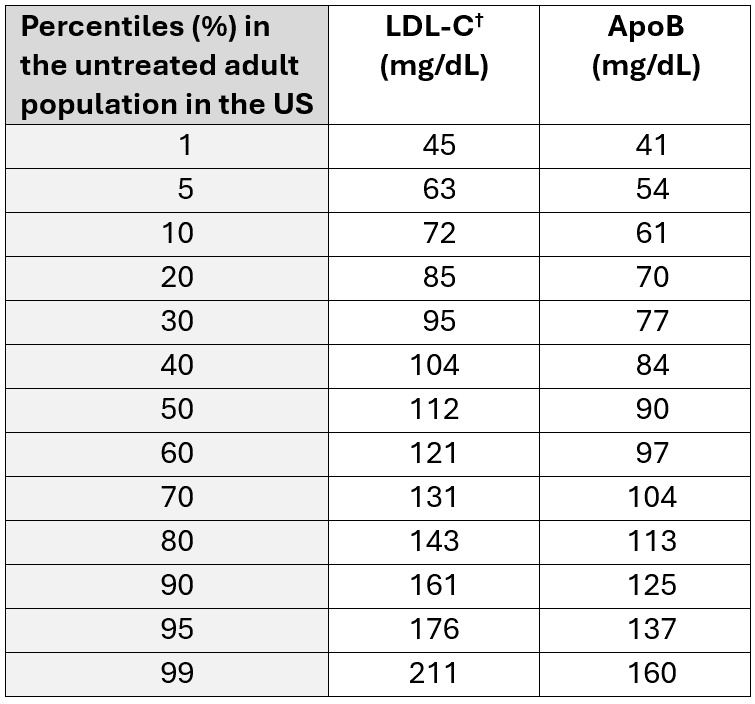
We can't compare the raw numbers of ApoB (total atherogenic particles) and LDL-C (amount of cholesterol).
Rather than comparing raw numbers, it’s more helpful to interpret LDL-C and ApoB using population percentiles.
• Concordant: Both values are in similar percentiles (e.g., both at the 50th percentile) → either test gives a similar risk picture.
• Discordant: One is significantly higher or lower than the other → ApoB is more predictive in these cases, because it reflects particle number, not just cholesterol content.
An analogy to summarize this:
👉 LDL particles are like trucks on a highway.
- LDL-C measures the total weight of the cargo (cholesterol) being transported.
- ApoB counts the number of bad trucks on the road (trucks that have an ApoB license plate).
Why it matters:
Some people have a few large LDL particles (normal LDL-C and normal ApoB). Others have many small particles—this can produce a normal LDL-C reading, but an elevated ApoB, signaling higher risk because more particles can infiltrate artery walls.
In conclusion:
For a group of people, typically with metabolic syndrome, diabetes, obesity, elevated triglycerides, or high Lp(a), LDL-C wouldn't fully depict the risk profile. This means you may have normal or average LDL-C levels but elevated ApoB, which could indicate a greater risk than initially assessed based solely on LDL-C.
Get Your Health Baseline For 2026
Health isn’t just what you see in the mirror—it’s what’s happening inside your body.
Your lab markers are your instruction manual. Knowing what’s in range—and especially what’s out of range—lets you personalize your health instead of guessing.
Function Health is an all-in-one health platform that starts with 160+ lab tests, covering your heart, hormones, liver, kidneys, thyroid, immune system, cancer signals, toxins, and key nutrients.
That’s about 5× more testing than standard primary care labs—bloodwork that would normally cost thousands of dollars out of pocket.
Scheduling is simple, with 2,000+ lab locations across the U.S., and most visits take around 15 minutes.
Once your results are ready, you receive a clear, comprehensive summary written by Function’s clinical team—and if anything urgent shows up, a clinician calls you directly.
With real data and personalized insights, you can take action, retest over time, and actually track whether what you’re doing is working.
This is the exact blood test my family and I get every six months.
Click here to sign up for Function Health for less than $1/day
Cholesterol: The Bottom Line
What's the takeaway?
The lower your LDL-C and ApoB, the lower your risk of coronary artery disease (CAD), strictly from a cholesterol standpoint.
LDL-C is still the standard of care and a reasonable place to start. But for most people, especially those with insulin resistance, obesity, or high triglycerides, ApoB offers a more precise and more accurate picture of cardiovascular risk.
ApoB was previously expensive and less widely available than standard lipid panels (though that’s changing with companies like Function).
As it stands today, LDL-C remains the "standard of care," but I wouldn't be surprised if ApoB becomes the widely used gold standard in the near future.
Only the best,
Jeremy London, MD
Related Articles
.jpg)





.jpg)
.jpg)
































































Subscribe for Free to Keep Reading
This content is free, but you must be subscribed to keep reading.